Thursday, 2 January 2020

AN EDUCATION MANIFESTO FOR 2020

Education is the passport to the future, for tomorrow belongs to those who prepare for it today.
LETTERS: EDUCATION is close to the heart of most, if not all, Malaysians. The Education Ministry has done well in many respects.
For example, last year, 51,191 students from the B40 group successfully enrolled in public higher education institutions through the Special Entry Path Initiative.
Meanwhile, another 4,369 school dropouts enrolled back in school as a result of the Zero Student Dropout Programme, and 4,821 special needs and 2,636 stateless children enrolled in schools due to the Zero Reject Policy.
Moving forward, I believe that the ministry will need to listen attentively to the voices of the young if it truly believes that the young are the future of this country. As one of the youngest, if not the youngest, full professors in the country, I feel obliged to issue a rallying call to the ministry to take bolder steps to accelerate education reforms this year.
In this call, I encourage the ministry to focus on five game-changing strategies for Malaysian education.
First, the ministry needs to walk the talk on diversity and inclusion. The Zero Reject Policy is a good start. But the real deal, I reckon, is to forge ahead with a single-school system, where the right to mother tongue is guaranteed and students have the opportunity to learn other languages. This strategy should enable our young to appreciate and respect other cultures.
It should also empower them to leverage on their mastery of foreign languages. This should prepare our future workforce to engage with the world’s biggest markets, which co-incidentally are the Muslim, Chinese and Indian markets.
Second, the ministry, which consistently receives one of the largest budget allocations every year, must spend prudently by promoting meritocracy to ensure the best return of the people’s investment.
For example, the ministry should treat education loans, such as those from the National Higher Education Fund Corporation, as a mechanism to democratise education.Student borrowers who can demonstrate excellence inside and outside the classroom can have these loans converted into scholarships.
If cost remains a concern, then this strategy can be implemented in stages, such as micro-credentialing and Technical and Vocational Education and Training certification, which can then be fed into higher level qualifications, such as bachelor, master’s and doctoral degrees.
Third, the ministry can scale the impact of educational initiatives by leveraging the technologies brought by the Fourth Industrial Revolution. For example, the ministry can use big data and Internet of things to identify and broadcast the lessons of the best teachers in the country. Students will benefit from well-executed lessons that can be replayed at home, and teachers can learn and build on best teaching practices.
Fourth, the ministry should pursue an education system that fosters and develops T-shaped characteristics among the young. This requires education policies and programmes that focus on developing the vertical stroke of the T, which represents specialisation, as well as the horizontal bar, which represents broader generic attributes such as communication, collaboration and leadership.
The future success of our country is predicated on our education system, which must excel in nurturing T-shaped professionals, as numerous studies on the future of work have emphasised the need to possess deep disciplinary knowledge along with a keen ability to operate effectively across disciplinary and socio-cultural boundaries.
Fifth, the ministry must realise that the country is losing too many of its top graduates to high profile careers at a time when Malaysians are exerting immense pressure to close the achievement gap.
Most often, the teaching profession is not on many top graduates’ radar, as careers in other industries, such as accountancy, engineering and medicine, can be financially tempting.
It is imperative that the ministry positions teaching as a highly rewarding career in the minds of top graduates, as high performing countries, such as Finland, South Korea and Singapore, have succeeded economically by recruiting teachers who are the cream of the crop.
This can be done by compensating teachers with industry-competitive salary packages and heightening the awareness about the effect that teachers can have on other people, and the positive changes they can make through this noble profession.
More importantly, we must always remember that education is the passport to the future, for tomorrow belongs to those who prepare for it today.

PROFESSOR DR LIM WENG MARC
School of Business,Swinburne University of Technology


* The views expressed in this article are the author’s own and do not necessarily reflect those of the New Straits Times

NEW STRAITS TIMES ONLINE

ACARA UTAMA 2020 / 2020'S BIG EVENTS

Acara Utama 2020 / 2020 Big Events

Sumber : Bernama Online

TAHUN MELAWAT MALAYSIA 2020 / VISIT MALAYSIA YEAR 2020 (VM2020)


Tahun Melawat Malaysia 2020 / Visit Malaysia Year 2020 (VM2020)
Sumber : Bernama Online

Wednesday, 1 January 2020

SELAMAT MENYAMBUT TAHUN BARU 2020

SELAMAT MENYAMBUT TAHUN BARU 2020

GREAT TEACHERS ARE GAME-CHANGERS

By incorporating arts performances in lessons, students can express their creativity and find their voice.
EDUCATORS are the nation’s game-changers ― playing the critical role in building, developing and shaping the future generation. They have the opportunity to mould students into lifelong learners, which will help them succeed beyond school life.
Dr Swaroop Rawal, a 2019 Global Teacher Prize finalist, said it was important to note that a teacher’s role is not only confined to teaching, but also a mover and a shaker.
Speaking in Kuala Lumpur recently, Swaroop revealed that becoming a teacher was never in her plans. When she became a mother, the former Miss India Universe, model and Hindi movie actress decided to leave her glam career and go into teaching.
She wanted to help children to be more resilient by equipping them with life skills and introducing new methods of teaching. According to Swaroop, teachers could build their students’ confidence by learning through play.
“This is because through play, they are not looked down by anybody and they feel they can do the tasks. So, how can we present our lessons in a way that’s fun for kids?
“For me, drama is the way,” she said, adding that incorporating drama and storytelling in the classroom came naturally for her.
2019 Global Teacher Prize Finalist, Swaroop Rawal
“It is something that my students enjoy a lot and the methods work really well,” she said, adding that she was always engaging ministers and bureaucrats in her country to bring about change in the education system.
“I am fighting to bring life skills education into classrooms because I want my children to be equipped with those skills that not only make them resilient, but emotionally empowered,” she said.
Educationist, consultant and trainer Puan Sri Sherina Leong-Aris said teaching is a calling and teachers should return to the basics of education to find inspiration and motivation.
Coming from a family of seven and growing up in a small room above a coffeeshop in Ipoh, Perak, Sherina was determined to break out of her family’s poverty and pursue a meaningful cause.
“I came from a poor family where we did not have much to eat. Life wasn’t great but we were happy.
“At that time, my parents only wanted me to finish school and get a job to support the family as I am the eldest daughter. Pursuing further studies was not an option.
“As fate would have it, my teacher put in the application for me to enrol in Form Six and I took the entrance exam. I was the only one who passed in the whole school. I started being a teacher at age 17, where I taught tuition to support myself through Form Six.
“Sharing a tiny room with other siblings, I did not have a proper place to study. My teacher was kind enough to invite me to study at her home. Every weekend, I would ride my bicycle to her house where I could eat good food,” she said.
Another unforgettable memory was the kindness and care shown to her by a teacher.
“I had another teacher who was concerned if I had tuberculosis because I was so thin. So, he took me to a doctor and found out that I was malnourished, which was a socioeconomic problem.
“That teacher told other teachers about my plight and they were all ready to help. Every month, they would send all sorts of groceries, such as milk, eggs and vitamin supplements to my household,” she said.
Sherina added that the sacrifices and deeds of her teachers had inspired her to become an educator herself.
“One of the main reasons why I teach is because I love kids. For me, the biggest reward for a teacher is when you see the light in the students’ eyes when they understand what you teach. I’m sure all teachers can relate to this.
“Teaching means you’re dealing with hundreds of young lives. We take responsibility for our students’ future,” she said.
Puan Sri Sherina Leong-Aris (right) with YTL Foundation programme director Datin Kathleen Chew during the keynote session at Leaps of Knowledge Conference.
Teach For Malaysia (TFM) English teacher Soonufat Supramaniam is advocating new initiatives by teachers for the future of education in Malaysia, no matter what constraints they face.
Having worked as a performance artiste, producer and movie director in Brisbane, Australia, Soonufat realised something about arts education that Malaysians should treasure.
Upon returning to Malaysia, he joined TFM and was posted to a rural school in Kedah.
While teaching English there, he explored how to combine language learning and performing arts.
He gathered 45 students from five rural schools to stage a play.
“The project discovered so much potential and talent. Even students from the most challenging areas could express themselves creatively and find their voice.
“I always believe that education should not be confined within the four walls of the classroom. It extends beyond that,” he said.
Swaroop, Sherina and Soonufat were sharing their experiences in the latest edition of the Leaps of Knowledge Conference organised by FrogAsia and YTL Foundation last year.
Themed HEART, the sessions were aimed at addressing issues, trends and initiatives in the education landscape.
The Global Teacher Prize is a US$1 million (RM4.09 million) award established by the Varkey Foundation to recognise exceptional teachers around the world, who made outstanding contributions to the profession.

NEW STRAITS TIMES ONLINE

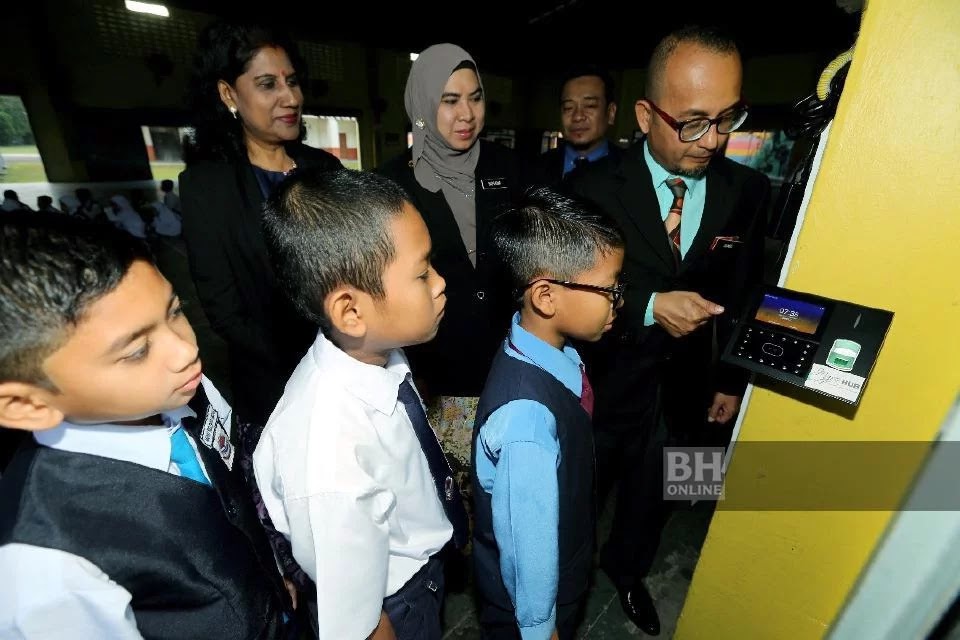
GUNA PENGIMBAS WAJAH REKOD KEDATANGAN MURID

GURU Besar, Zamri Abd Wahab menunjukkan murid Sekolah Kebangsaan Taman Perling menggunakan teknologi peranti pengimbas muka untuk mendaftar kehadiran ke sekolah pada hari pertama persekolahan di Sekolah Kebangsaan Taman Perling, Johor Bahru
JOHOR BAHRU: Sekolah Kebangsaan (SK) Taman Perling, di sini menempa sejarah sebagai sekolah pertama di negara ini menggunakan teknologi pengimbas muka bagi merekodkan kedatangan murid.
Lebih menarik apabila kemudahan canggih itu hanya mengambil masa kira-kira dua saat bagi mengimbas wajah murid sebelum maklumat peribadi seperti nama penuh, nombor murid dan darjah mereka disimpan terus dalam pangkalan data sekolah.
Guru Besar SK Taman Perling, Zamri Abd Wahab, berkata seramai 1,034 murid membabitkan 937 murid aliran perdana, 47 murid Pendidikan Khas dan 50 murid pra-sekolah menggunakan teknologi imbasan wajah untuk mencatat kehadiran mereka bermula hari ini.
Katanya, sebanyak dua unit pengimbas muka diletakkan di dewan untuk merekod kehadiran murid bagi dua sesi persekolahan, manakala sebuah lagi mesin itu ditempatkan di pejabat sekolah untuk mencatat kedatangan 76 guru dan 12 kakitangan sekolah.
“Ini bagi memudahkan guru merekodkan kedatangan murid, malah tidak perlu lagi menggunakan kaedah manual, sekali gus membantu mengurangkan beban kerja guru.
“Ia sudah boleh digunakan tetapi memerlukan sedikit masa bagi mendaftarkan semua maklumat murid termasuk nama penuh, umur dan darjah mereka ke dalam sistem yang akan dilakukan secara berperingkat minggu ini.
“Semua data kehadiran murid akan disimpan dalam sistem berkenaan sebelum disalin dan dipindah ke pangkalan maklumat Kementerian Pendidikan melalui Aplikasi Pangkalan Data Murid (APDM),” katanya ketika ditemui selepas perhimpunan pertama sekolah berkenaan, di sini hari ini.
Sementara itu, Naib Yang Dipertua Persatuan Ibu Bapa dan Guru (PIBG) SK Taman Perling, Datuk Suhaila Ahmad, berkata kemudahan itu disumbangkan secara percuma oleh Myra Hub Foundation untuk sekolah berkenaan bagi kemudahan murid dan guru.
Katanya, SK Taman Perling 1 menjadi sekolah pertama di negara ini yang mencatat kehadiran murid menggunakan teknologi pengimbas muka berbanding teknologi kod QR yang dilaksanakan institusi pengajian tinggi negara dengan meluas.
“Kos pemasangan, perisian dan penyelenggaraan yang berjumlah lebih RM50,000 semuanya dibiayai Myra Hub Foundation menerusi teknologi pengimbas wajah dibangunkan RN Technologies Sdn Bhd.
“Pada pagi ini, kita mengambil masa 10 saat untuk memasukkan data nombor murid dan mengimbas anak mata murid bagi disimpan di dalam sistem. Selepas semua data murid disimpan, proses mengimbas wajah hanya akan mengambil masa dua saat bagi setiap murid.
“Sistem ini akan mengenal pasti 30 titik sudut mata murid, guru dan kakitangan sekolah dalam proses mengimbas wajah sebelum data kehadiran mereka disimpan, ” katanya.
Bagi murid Tahun 6 Bijak SK Taman Perling, R Kivesha, berkata dia bersama rakannya begitu teruja menggunakan teknologi pengimbas wajah berkenaan buat pertama kali.
“Saya selalu hanya lihat di televisyen mengenai teknologi pengimbas wajah ini namun tidak sangka boleh merasai pengalaman itu di sekolah,“ katanya.


BERITA HARIAN ONLINE

HANYA LIMA MURID TAHUN SATU DI SK DUSUN

HANYA lima murid Tahun Satu yang mendaftar di Sekolah Kebangsaan (SK) Dusun, Hulu Terengganu, pada hari pertama persekolahan hari ini.
KUALA BERANG: Saban tahun, bilangan murid Tahun Satu yang mendaftar di Sekolah Kebangsaan (SK) Dusun di sini, sememangnya kecil dan ia kelihatan semakin berkurangan tahun ini dengan hanya lima murid.
Guru Besar SK Dusun, Mohd Soffi Othman, berkata tahun lalu pihaknya mendaftarkan 10 murid Tahun Satu, namun bilangannya berkurangan separuh bagi sesi 2020.
Beliau berkata, murid Tahun Satu yang mendaftar di sekolah itu hari ini adalah anak penduduk Kampung Dusun dan Kampung Pueh.
“Keseluruhannya SK Dusun mempunyai 65 murid, termasuk lima murid Tahun Satu.
“Selain itu, sekolah ini menempatkan sembilan murid Tahun Dua, Tahun Tiga (16), Tahun Empat (15), Tahun Lima (sembilan) dan 11 murid Tahun Enam,” katanya ketika ditemui di sini, hari ini.
Beliau berkata, situasi itu bukan luar biasa berikutan sekolah itu dikategorikan Sekolah Kurang Murid (SKM).
Katanya, faktor penghijrahan ibu bapa ke kawasan bandar untuk bekerja menyebabkan sekolah di kawasan kampung termasuk SK Dusun semakin berkurangan murid.
“Bagaimanapun, ia memberi kelebihan kerana guru kerana boleh memberi tumpuan kepada murid untuk pembelajaran dan pengajaran yang lebih berfokus dan berkesan, sekali gus melahirkan murid cemerlang,” katanya.
Sementara itu, Pengarah Jabatan Pendidikan Terengganu, Salim Ab Ghani, berkata seramai 225,565 murid di 503 sekolah di negeri ini mendaftar bagi sesi persekolahan tahun ini.
Jumlah itu membabitkan 128,609 murid sekolah rendah dan 96,956 pelajar sekolah menengah, dengan 21,273 murid Tahun Satu dan 18,178 pelajar Tingkatan Satu.
“Jumlah murid Tahun Satu yang mendaftar menurun 1.5 peratus, berbanding seramai 21,595 murid Tahun Satu yang mendaftar tahun lalu,” katanya.
BERITA HARIAN ONLINE